Monday, April 30, 2007

Furore over the flag


At both ends of the Cricket World Cup played at the Caribbean, the Indian National Flag was at the centre of a controversy.

Bollywood Star and TV anchor Mahindra Bedi was just recovering from the outrage of the Sikh Community for for displaying a Sikh religious symbol 'Ek Omkar'on her semi nude back below the neck as a tattoo.

"Ek Omkar" (God is One) are the first words of the Sikh scripture, the Guru Granth Sahib.

The Sikh community was incensed that Manhindra was hurting their religious sentiments. They demanded that she apologise and she promptly gave them one which was accepted.

The dust hardly settled down before she found herself in the news again, for the wrong reason.

Now she isn't just reporting the news. She is also news.

As the TV anchor hosting the final between Sri Lanka and Australia, to the dismay of many Indians she came into the show wearing a saree - designed by Puneet Nanda of designer label Satya Paul — that had flags of all countries in the World Cup.

TV footage showed that the Indian flag appeared in the folds of her saree below her knee, near her foot. Soon she realised the storm she caused again. She changed her saree and the show continued. She and her designer offered a profound apology but the damage was already done.

A Jaipur resident, accused Mandira of disrespecting the tricolour by wearing it as a design on her sari and has lodged a police case against her.

Before the World Cup began, India's star batsman Sachin Tendulkar found himself unintentionally flouting the national flag. At a party on March 11 held by the Indian High Commissioner to Jamaica, K L Agrawal, Tendulkar was seen cutting a cake.

It would seem that there is nothing wrong here for a party that included the entire Indian team. But there was a problem. Photographs clearly showed the tricolours of the Indian flag on the cake.

As per the Prevention of Insults to National Honour Act, 1971, not only is this act unethical and insensitive, but it also amounts to an offence with a maximum of three years imprisonment or fine or both.

The Indian Cricket Board quickly reacted to calm the irritated nerves. They said the incident should not be blown out of proportion as Tendulkar was a person who would never show any disrespect to the national flag.

"Tendulkar has spoken to me. He says that the function was organised by the India High Commission and with so many people around he did not realise the colour of the cake when he was suddenly asked to cut it," BCCI Vice President Rajeev Shukla said.

Shukla said that Tendulkar could not be held responsible as it was a function organised by the Indian High Commission.

"The High Commission should have taken care of these things".

"Tendulkar will not do such a thing intentionally. He respects the national flag and had even sought permission to use the tricolour on his helmet. If an explanation is sought, it should be sought from the Indian High Commission", Shukla said.

The Union Minister of State for Home, Sriprakash Jaiswal said that in all probability it was unintentional.

"The person who made the cake should be held responsible for this," he said.

Irony over irony- imagine the fall guy who has to bear responsibility.

Sunday, April 29, 2007

Playing mind games

In soccer, the English Premier League or EPL is widely regarded as one of the best leagues in the world along with Spain's La Liga and Italy's Serie A.

As the EPL season is drawing closer to the end, tensions are rising between the title contenders; defending champion Chelsea following closely on the heels of the current leader Manchester United.

The tensions rose to fever-pitch this week when Chelsea's outspoken manager Jose Mourinho alleged that Manchester United have benefited from refereeing bias this season.

Although Manchester United's manager Alex Ferguson gave a pass to Mourinho's barbs, Man United's supremely confident Ronaldo decided to jump in against his countryman.

In a remarkable exchange of insults, Portuguese television viewers were treated to their country's most famous manager accusing their country's most famous player of "lying" and warning Ronaldo that he would never be the best player in the world.

Mourinho was responding to a slight from Ronaldo that the Chelsea manager did not "know how to deal with his failures".

With Chelsea on for an unprecedented quadruple of trophies, and United chasing the treble, feelings are understandably running high.

The latest saga began after his Chelsea's draw with Newcastle, when Mourinho announced, tongue-in-cheek, that there were "new rules" that dictated his side would not be awarded penalties and that United would not have penalties awarded against them.

When the competition is this intense, managers of the top teams routinely indulge in playing mind games before the players take to the field, in order to gain a psychological advantage over opponents.

We saw the ugly side of players behaviour in the world cup final of 2006 between France and Italy played in Germany.

Zinedine Zidane, a three-time FIFA world player of the year, who is known to have a temper, was touted throughout the match by the Italian defender Materazzi, calling names and hurling him abusive language.

In the dying minutes of the evenly balanced game , to everyone's surprise, Zidane head-butted Materazzi. Zidane was ejected from the match, unceremoniously ending a glorious career. France lost the match on penalties plunging a nation into mass mourning.

Saturday, April 28, 2007

International cricket has lost its soul

Malcolm Speed, chief executive of the International Cricket Council(ICC) commenting on the mysterious death of Pakistan coach Bob Woolmer, said: "We must demonstrate that cricket cannot be put off by a criminal cowardly act."

Woolmer an outstanding former player and a devoted coach was found dead in his room, under suspicious circumstances the night after his team was unexpectedly knocked out in the first of the World cup at Caribbean.

This was a sordid crisis for international cricket against the background of past incidents of match-fixing which is a huge illegal industry in the sub-continent.

Speed's comment quickly was echoed by other pundits who claimed, "the games must go on." These words seem rather hollow when you consider that Woolmer was one of their own and ICC does share a collective responsibility.

Cricket used to be the gentleman's game which is reflected in the white attire that players wear for the longer version of 5-day test matches.

The game has now been corporatised to attract big money between competing nations in the limited overs series of the one-day games. For these limited-over games players don the colours of their national flags and the game is played evoking national pride.

Free market capitalism now drives a vast machinery over the simple pleasure and joy of playing the game. The genteel nature of the game's tradition has been replaced by the greed for making huge profits from sponsorship and merchandising.

The International Cricket Council (ICC), the sports governing body has announced that the sale of sponsorship rights for the eight-year period starting after the completion of the current World Cup in Caribbean is expected to bring in $500 million on top of the $1.1 billion for the sale of broadcast rights to ESPN-STAR Sports.

With more one billion fanatical cricket fans, The Board of Control for Cricket in India, or BCCI, is richest sporting body and one of the richest sports team or body in the whole world.

The over-reaction to the Indian cricket team's early elimination from the World Cup after its defeat by Sri Lanka has been so gross that one must worry about the future of that sport in India, with all its identifications with national self-esteem, honour, and its numerous connections with media exposure, advertising, corporate sponsorship, and not least, gambling.

The Indian players, once elevated to the status of demi-gods, have suddenly become demons, devils, villains, and worse, traitors.

This cricket obsession isn't natural or spontaneous. It has been systematically cultivated or manufactured through multi-billion dollar marketing, sales promotion and advertising.

In India, cricket is more than a national pastime, it is a fanatical obsession of millions, a few die-hard fans would rather die than see the humiliation of their team being knocked out .

Indian top star players make millions of Rupees a year for endorsing products ranging from shoes and cosmetics to foods and drinks.

Big Corporations invest in everything, from cricket-related ground events, trophy tours, consumer promotion and glamour shows. The all-pervasive, predatory and manipulative influence of corporations in cricket wouldn't have become possible without ICC turning this beautiful game into a profit seeking giant.

Even in the world cup at the Caribbean this time, most of the games had half filled stadiums as the price of tickets was set too high. ICC didn't quite figure out how to set ticket prices to attract more supporters in a contest that maintains a four-year cycle. For the fans this world cup is a huge disappointment, but it appears ICC is pleased that it has made money nevertheless.

Friday, April 27, 2007

Stephen Hawking flies weightless


Zero Gravity Corporation, the private company that operates the zero gravity simulating plane has offered a free ride to the famed Cambridge professor Stephen Hawking

The 65-year-old scientist, who is confined to a wheelchair due to a degenerative disease , said he wanted to make the flight to build awareness for the importance of space exploration.

"I believe that life on Earth is at an ever-increasing risk of being wiped out by a disaster such as sudden global warming, nuclear war, a genetically engineered virus or other dangers," Hawking said before his flight.

With four doctors and two nurses on hand, the astrophysicist took upto an altitude of about 24,000ft above ground. The plane, a specially modified Boeing 727 jet, hikes steeply towards the sky, then arches over to plunge downward. The descent temporarily lifts the bonds of gravity.

The professor's verdict after the flight which was evident from his broad grin before he twitched the controls of his computer, : "I could have gone on and on."

He had no problem with the experience.

Pope goes green

Finally the Vatican has sent a strong signal calling on the faithful to protect the earth. Mother earth is in pitiful state and several species may get wiped out due to the looming changes expected on the climate caused by industrial pollution and global warming.

The Vatican yesterday added its voice to the alarms from churches around the world that abuse of the environment is against God's will. The Pope has urged that the one billion-strong Catholic church must become far greener.


At the Vatican conference on climate change, Pope Benedict urged bishops, scientists and politicians - including UK environment secretary David Miliband - to "respect creation" while "focusing on the needs of sustainable development".

An interesting speculation among some evangelical leaders suggest that global warming is not human induced and they have argued that the collapse of the world is inevitable and will herald the second coming of Christ.

Their younger leaders who have broken ranks with them are working to influence politicians and financiers formulate environmentally sound polices to bring about sustainable development.

Wednesday, April 25, 2007

Second Earth has thirteen days a year


This artist's rendering, released by European Southern Observatory, shows the planetary system around the red dwarf Gliese 581.
Photo: AP/ESO

More on this story here.

Tuesday, April 24, 2007

Yeltsin leaves a mixed legacy

Boris Nikolayevich Yeltsin, the man who defeated decades of communism and became first democratically elected president of Russia in the post-Soviet era, is dead at the age of 76.

Commentators in the Russian media are assessing the controversial career and political legacy of the larger-than-life Yeltsin who served as president from 1991 to 1999.

The image of Yeltsin standing on a tank outside the Russian Parliament in defiance of communist hard-core loyalists is etched in the collective conscience of the Russian people.

While world leaders are hailing Yeltsin as a courageous leader whose unwavering determination brought democracy to Russia, many Russians blame him for the hardships unleashed by free market reforms.

Yeltsin's new capitalism got rid of massive subsisidies while the free market reforms allowed unrestriced prices to be set by private parties, plunging millions into poverty overnight.

Introducing capitalistic free market into a communist culture was a daunting challenge for Yeltsin who became more unpopular in his later years.

Yeltsin's health deteriorated from the excess of heavy drinking which became the subject of many jokes, creating an unfavourable image at home and abroad.

Mikhail Gorbachev, the last Soviet president, summed up the complexity of Yeltsin's legacy in a condolence statement minutes after the death was announced. He referred to Yeltsin as one "on whose shoulders are both great deeds for the country and serious errors," according to the news agency Interfax.

To his credit, Yeltsin carried his country through a turbulent transformation with far less bloodshed than many had feared, and the new Russia is his legacy.

Bad Parenting and Free Speech

Actor Alec Baldwin's verbal tirade against his 11-year-old daughter was exposed last Thursday by the celebrity Web site TMZ.com. They posted a recording of the abusive phone message Baldwin had left the child, calling her a “rude, thoughtless little pig.”

Baldwin who has apologized for his outburst has accused his ex-wife Kim Basinger, alleging that she leaked a private message to the public. The couple have fought a bitter six-year custody battle over their child.

In the United States the freedom of the press to report and inform the public is a right guaranteed by the bill of rights or the constitution. The purpose being to make it possible for the citizens to make informed choices and decisions.

Thus, information that is brought into the public domain ought to have some benefit for the public good or must contribute to the greater good of society.

What good is there in publicly exposing Baldwin's over-the-top outburst meant only for his daughter?

If Baldwin's rant and name calling rises to the level of domestic abuse, this matter ought to have referred to the court rather bring it for public consumption. Repeating his threatening remarks in the 24-hour news cycle only causes more pain and hurt to his daughter.

It is pathetic to see adults acting in this manner.

Monday, April 23, 2007

Money and Power

Money is a symbol that represents the value of goods and services. The acceptance of any object as money involves the consent of both the individual user and the community.

Thus, all money has a psychological and a social as well as an economic dimension. As human consciousness has evolved, the nature and function of money has evolved too.

Power is broadly defined as "the capacity to bring about change." It takes many forms, comes from many places, and is measured in many ways.

Here is an answer that the social thinker Professor John Kenneth Galbraith gave during a discourse about these very complex emotions.

"There are two things that people pursue in life, not wholly unrelated.

One is money and the other is power. And we see this and take it for granted. The attraction of power we take for granted in politics, in your field, where people spend tens of thousands, hundreds of thousands, and now millions of dollars in order to have positions in Washington or Sacramento or wherever, where they have power.

But in economics, classical and neoclassical economics, that has no particular role. The thrust there is for pecuniary return, for money. And I have always felt, and still feel very strongly, that that denies in the economic world a very large part of the motivation.

People want to be head of General Motors, or General Electric, or General Mills, or another of the other, shall we say, "generals" -- they want those jobs certainly for the income that is returned. But the income is itself a measure of the prestige and power, authority, that goes with achieving those positions.

And so I have tried in some of my writing, how successfully I don't know, to bring power back into a role in economic motivation. I gave an address some years ago which has been quite widely reproduced, my presidential address of the American Economics Association, I called "Power and the Useful Economist." One is not useful in economics unless one brings the thrust for power into appreciation, consideration."

Meetings

Meetings are a great trap. Soon you find yourself trying to get agreement and then the people who disagree come to think they have a right to be persuaded. However, they are indispensable when you don't want to do anything.

John Kenneth Galbraith

Sunday, April 22, 2007

Brian Lara departs a flawed genius

Over a career that spanned 17 years, Brian Lara has been a batting supremo of mesmerising charm who has entertained crowds on the world stage of international cricket.

To many of his fans and cricket lovers, the end came too soon when a terrible mix-up with Marlon Samuels limited Brian Lara to just 18 in his final international innings yesterday.

With a Test average of 52.88 from 131 matches and an ODI average of more than 40, Lara has done enough to look back with pride on a glorious career.

Lara who came into the West Indies team in the early 1990s, when there were still great cricketers, has been criticised as setting the wrong example. The West Indians' practices, according to observers, have been the shoddy and undisciplined consequences of late-night partying.

With Lara's team already out of the world cup, Lara has been roundly criticised during this World Cup campaign, with legends of the past dismissive of both the team's performances and preparation.

Lara has captioned his team thrice and few have made the game look better than he did. For better or for worse, no one else has shown such individual brilliance in a team sport.

Cheers to Brian Lara.

Saturday, April 21, 2007

The benefit of a positive mental attitude

YOUR MENTAL ATTITUDE IS THE MOST DEPENDABLE KEY TO YOUR PERSONALITY.

Your view of yourself will greatly influence how others perceive you. If you are a confident, cheerful, positive person, your co-workers, friends, and family will be attracted to your personality.

If you are unhappy, negative, and always complaining about your situation, others will be repelled. Even when at times you don’t feel very happy, by forcing yourself to behave in a positive fashion, you will find that you soon feel genuinely upbeat, because your subconscious mind doesn’t know the difference between an artificial emotion and the real thing. When you behave positively, you will positively influence everyone around you-including yourself.


This positive message is by the Napoleon Hill Foundation. http://www.naphill.org/.

Thursday, April 19, 2007

India is innovating...

The full title of Rediff's article reads: 'India is innovating its way out of poverty.'

A pioneering research published on April 9 in Nature Biotechnology said that India's health biotech firms are emerging as major global players, with growing means and knowhow to produce innovative as well as generic drugs and vaccines at a fraction of a cost compared to those produced by global giants.

"India is innovating its way out of poverty . . . it is poised to revolutionise biotechnology just as it did the information technology industry," says Professor Peter A Singer, principal author of the research study.

India has a number of poverty reduction programmes initiated since the 1960s.

India is a federation of states and 75% of indian population depends on agriculture whereas its contribution of agriculture to the GDP was 22%.

For most of its post-independence history, India adhered to a quasi-socialist approach, with strict government control over private sector participation, foreign trade, and foreign direct investment.

However, since 1991, India has gradually opened up its markets through economic reforms and reduced government controls on foreign trade and investment.

In the 1980s and early 1990s, Indian government programs attempted to provide basic needs at stable, low prices; to increase income through pricing and regulations, such as supplying water from irrigation works, fertilizer, and other inputs; to foster location of industry in backward areas; to increase access to basic social services, such as education, health, and potable water supply; and to help needy groups and deprived areas.

Nothwithstanding a vibrant economy and the tremendous innovation that is taking place in the service industries, India still has many challenges in the distribution of wealth and poverty reduction. India has world's largest concentration of people in poverty-more than 300 million.

Wednesday, April 18, 2007

US mourns campus mass murder


Heart-breaking stories of the all too familiar school shootings has happened yet again.

Tragically a deranged senior student brutally gunned down the lives of 32 people including students and teachers of Virginia Tech University on Monday.

Virginia Tech - a sprawling complex of over 100 buildings on 2,600 acres - has 26,000 residents.

Monday's shootings occurred in two separate locations, two hours apart.

It was the worst since Charles Whitman went to the top of a tower at the University of Texas on Aug. 1, 1966, and opened fire. He killed 15 people, including his mother and wife the night before, and wounded 31 others.

The massacre Monday took place almost eight years to the day after the Columbine High bloodbath near Littleton, Colorado. On April 20, 1999, two teenagers killed 12 fellow students and a teacher before taking their own lives.

As police begin to unravel how 32 people were killed , the authorities were facing tough questions over why they waited more than two hours to inform staff and students of the first murders.

Were there any warning signs that may have given out clues that one of their own students could embark on this ferocious killing spree?

In the wake of this tragedy many questions are being asked and will stir the US debate over gun control and what drives people to go on shooting rampages through schools and colleges.

Cho Seung-hui, the 23-year-old South Korean student who carried out America's deadliest massacre was in the final year of an English degree at the university. He was a loner. His creative writing was apparently so disturbing that his teacher referred him to the university's counselling service for help.

People who commit killings in schools and colleges are sometimes motivated by a specific grievance against that institution or people within it, said Nadine Kaslow, a professor and chief psychologist at Emory School of Medicine.

They are sometimes mentally ill and may equally be reacting to a trauma, either real or imagined, that they have suffered, and decide to take that trauma out on everyone else, Kaslow said in an interview.

The Huffington Post says the US has to be honest about what price it has to pay if gun ownership is to stay legal.

Advocates of gun freedom such as the National Rifle Association argue that the right to bear arms is enshrined in the U.S. constitution and dispute efforts to link the incidence of gun crime with access to firearms.

Many recent studies have looked at student-on-student violence and its causes and after Columbine intense scrutiny focused on the lives and backgrounds of the two gunmen, who committed suicide.

It also focused on school bullying, social cliques and the potential effects of the music they listened to and the video games they played. Experts also looked for ways to spot warning signs of violence.

Sadly, university campuses in the US seem to be wide open spaces where criminally-minded individuals are able to carry out their warped fantasies.

In the days and months ahead there will a lot of soul-searching over how this senseless shooting happened and to determine ways to provide a safe learning environment.

Tuesday, April 17, 2007

Bollywood-style kiss sparks outrage in India


Hollywood actor Richard Gere's repeated kisses on the cheeks of Bollywood actress Shilpa Shetty (as shown on the photo by Reuters) in an onstage event to promote AIDS awareness sparked protests in India with demonstrators burning effigies of the actors.

In Indian Bollywood films, romantic songs and dances are a common feature and one wonders what all the fuss is about relating to what Gere did.

Gere is a well-known Buddhist and an active supporter of the Dalai Lama. He has also been a persistent advocate for better human rights in Tibet and campaigns for AIDS awareness.

Hindu radicals have gone on a rampage in several north Indian cities Monday to protest describing the actors pose as an intolerable and obscene act. It is against the values, culture and traditions of the nation, they claimed.

A defiant Shilpa Shetty who is in the eye of the storm reacted angrily over the burning of the effigies and the protests by the Shiv Sena across the country.

"Nobody is talking about the real issue. I think the only mistake was that it went slightly overboard," Shilpa said.

Defending Gere's "impromptu act", Shilpa said instead of asking him to apologise "we should be thankful to him for doing so much for the cause".

Expressing her anguish over the media's handling of the issue, Shilpa said, "I want to know from the media and people giving reactions. What have they done for the cause?

"We took out time and put money, and people are going against us, they want us to apologise. For what should we apologise, we have talked about a pertinent issue like AIDS," Shilpa said.

Shilpa has subsequently said that Gere has spoken to her three times and repeatedly apologised if he has hurt anyone's feelings.

This whole incident smacks of racial bias and bigotry.

Monday, April 16, 2007

Does globalization level the playing field?


In the olden days, daring explorers set sail across the vast oceans of the sea in search of gold, spices or in the quest to expand their imperialistic powers.

These travellers came to the realisation that there was no edge at the world. It was false to believe that they will to fall into an abyss of darkness. Indeed they proclaimed that the world was round and you can go around it.

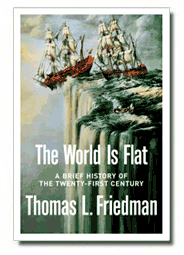
Centuries later, a Pulitzer Prize winning journalist who is a contributor to The New York Times has proved otherwise: the world is flat.

We are told the world has changed and with it everything else continues to change. So were the early explorers flat wrong?

In his thought-provoking book 'The World is Flat' Thomas Friedman reveals the maddening changes that the modern society is going through.

It is the globalization: the global connectivity, integration and interdependence in the economic, social, technological, cultural, political, and ecological spheres.

Friedman employs the metaphor of the flat world to describe how globalization—taken up to an almost sky-scraping height and down to an even more unimaginable depth—has levelled the “playing field.”

Friedman believes the world is flat in the sense that the competitive playing fields between industrial and emerging market countries are leveling. Friedman recounts many examples in which companies in India and China are becoming part of large global complex supply chains that extend across oceans through a process called outsourcing, providing everything from service representatives and X-ray interpretation to component manufacturing.

He recalls seeing such major American companies as Dell, AOL, and Microsoft using Indian teleoperators who are paid much less than their counterparts in the West. He describes how these changes were made possible through intersecting technologies, particularly the Internet, fiber-optics, and the PC.

Some opponents of globalization see the phenomenon as the promotion of free trade and corporate interests, their primary motive being to increase profit rather than creating jobs for a self-fulfilling life style.

The eighteenth century economist Adam Smith who propagated the idea of free trade spoke of “laissez-faire” economics in his book 'The Wealth of Nations.' He taught that privatized business and trade promotes more economic activity than state controlled business and thus could provide even more money from the state through the collection of income taxes.

Smith's market economics theory does not guarantee jobs or a middle-class society. Free trade lies in the principle that if trade is free, certain goods and services can be obtained at lower cost abroad than if domestic substitutes are produced in their place.

Smith's market economics has worked for the past 200 or so years in the US and the free world. The collapse of communism has added momentum to the global trend toward free trade and free markets.

During the 1990s governments across the world embraced free-trade policies, including countries that once belonged to the communist bloc, such as Russia, Poland, and China. By the early twenty-first century free trade had emerged as a cornerstone of the new global economy.

But past performance is no guarantee of future performance. The pace of change in technology is accelerating, and the economic issues and problems that result from new and unexplored territory.

Even in a flight of imagination, would Smith have envisaged the transformation that we are going through now, from blue-collar workers to knowledge-workers?

In the 21st century a new debate is raging on the benefits and the downside of globalization even while we are still on the trail of the holy grail shown to us by Smith's division of labour that is so important for production in a free market.

As Peter Drucker describes in his ' Post-Capitalist Society,' every few hundred years a sharp transformation affects the society we live in.

According to Drucker, we are right in the middle of another time of radical change, from the Age of Capitalism and the Nation-State to a Knowledge Society and a Society of Organizations.

The primary resource in the post-capitalist society will be knowledge and the leading social groups will be "knowledge workers." This transformation profoundly affects our society - its worldview, its basic values, its business and economics, and its social and political structure.

It's time to look beyond Smith's free market to solve our current problems of wealth creation, wealth distribution and a sustainable environment.

In historical terms, globalisation does provide the best reach and the maximum opportunities to solve our social problems.

Will it emerge as a level playing field? The jury is still out on this question for we have a long way to go.

Sunday, April 15, 2007

Capitalism and Environment

While scanning through the net, here's a gripping article that I came across which is definitely worth thinking about.

Capitalism in not sustainable by its very nature. It is predicated on infinitely expanding markets, faster consumption and bigger production in a finite planet.

Business is the cornerstone of every capitalistic economy. Most of the countries in the world practise capitalism in one form or the other.

The world's scientists have warned that hundreds of millions may be at risk due to the impacts of global warming and the ensuing climate change.

The industrialised world and the developing countries that are pursuing a relentless pace of economic development need to heed the scientific findings and reduce the deadly greenhouse gases that is adversely affecting the planet that we live.

It is time for governments and business corporations to show strong leadership, not only to grow economic prosperity but to do it in an environmentally sustainable manner.

That seems to be the challenge faced by the world.

Saturday, April 14, 2007

Wolfowitz chastised for nepotism

Mr. Paul Wolfowitz - the arch neo-con who played an important role as Deputy Secretary of Defence to Donald Rumsfeld in the run upto the Iraq war – is taking the heat for arranging a promotion and pay rises for his girlfriend and World Bank staff Shaha Riza, in possible violation of bank rules.

This is the kind of personnel nepotism and corruption that Wolfowitz has stated he is trying to wipe out at the Bank and in the client governments of the Bank.

Now his own personal behavior belies what was his self-declared moral campaign against others' corruption both inside the bank and in client country governments.

It was amazing to see Wolfowitz getting booed by his own employees in a meeting of the bank's governing board that met two days back to decide his fate.

Amid calls for his resignation, Mr Wolfowitz yesterday repeatedly apologise for his role in this controversy.

Aid agencies said the controversy was distracting the world's leading aid institution from carrying out its role as a leader in development at a vital time. "The world's poor cannot afford a lame duck president at the World Bank," said Oxfam.

In a strongly worded editorial, the Financial Times also called on Mr Wolfowitz to stand down. Calling the controversy "lethal" to the bank's credibility, the paper's leader column said: "In the interests of the bank itself, he should resign. If he does not, the board must ask him to go."

Mr Wolfowitz's fate now lies in the hands of the bank's executive board members, each representing the World Bank's major donor nations, ranked by shares reflecting the importance of their stake. The bank's regulations allow the president to be dismissed by a simple majority of votes by shareholders - the US being the largest with 16% of shares.

So far, individual countries have not voiced any public support for Mr Wolfowitz, with executive board members awaiting instructions from their country's finance ministers, who are gathering in Washington this weekend for meetings.

The whole affair is a huge embarrassment for the bank and Mr Wolfowitz, especially given his desire for a tough stance against corruption and rewards for good governance. Critics say that Mr Wolfowitz's own actions have now made a mockery of those aims.

Friday, April 13, 2007

A question of death tax

"The question is not what anybody deserves. The question is who is to take on the God-like role of deciding what everybody else deserves.

You can talk about 'social justice' all you want. But what death taxes boil down to is letting politicians take money from widows and orphans to pay for goodies that they will hand out to others, in order to buy votes to get re-elected. That is not social justice or any other kind of justice."

-- Thomas Sowell(1930- ) Writer and economist

http://quotes.liberty-tree.ca/quote_blog/Thomas.Sowell.Quote.7100

Thursday, April 12, 2007

I-Man's joke testing limits of free speech

A racial slur uttered by the US well-known radio host and comedian Don Imus also known as the I-Man is causing national outrage.

The controversy began when Imus characterized the Rutgers women's basketball team, one of the two best women's basketball teams in America as "nappy-headed hos."

Imus spewed the racist remarks on his radio show. Imus' radio show originates from WFAN-AM in New York City and is syndicated nationally by Westwood One, both of which are managed by CBS Corp. (MSNBC, which simulcasts the show on cable, is a part of NBC Universal, which is owned by General Electric Co.)


Imus, 67, is a hard-core shock jock and has gone past the edges of propriety many times during his long career. He makes a living by spreading verbal insults disguised as humour, once calling Colin Powell a 'weasel' and another time referring to New Mexico Gov. Bill Richardson as a 'fat sissy.'

His comments about the Rutgers women crossed the line and several prominent advertisers announced plans to distance themselves from the talk show host.


The fallout from the comments continues to build momentum. Office supply chain Staples Inc. and Procter & Gamble Co. said they pulled advertising from Imus' show, and Bigelow Tea said the remarks have 'put our future sponsorship in jeopardy.'

Calls for the radio host's dismissal have been growing, including from groups such as the National Organization for Women and the National Association of Black Journalists.

Imus has apologized repeatedly for his comments. He said Tuesday he hadn't been thinking when making a joke that went 'way too far.' He also said that those who called for his firing without knowing him, his philanthropic work or what his show was about would be making an 'ill-informed' choice.

Amidst the chorus of voices getting louder to fire him or take action, some legal experts say that Imus engaged in parody and there was no ill-intent on his part to demean anyone.

Freedom of speech and parody are First Amendment rights and the The Federal Communications Commission (FCC), the independent United States government regulatory agency may not intervene as Imus has not demonstrated malice or broadcast obscene or indecent programming.

Imus’s friends say that he is not a racist in his heart. But what is or is not in the heart of a radio talk show host is much less important than what comes out of his mouth.

Wednesday, April 11, 2007

Teamwork does great for Man Utd


The smiles confirm the story as Wayne Roony celebrates Michael Carrick's second goal of the night when Manchester United thrashed Roma 7-1 in front of a full house crowd at Old Trafford.

"This will go down in the history books as one of Manchester United's best European performances," said Graham Taylor the Former England manager.

Ferguson hailed the victory as their best ever - a fantastic performance by every one of their players he said.

Roma coach Luciano Spalletti was at a loss to explain what happened to his side who had a 2-1 advantage from the first leg, coming into this game.

The Red Devils were firing on all cylinders, Ferguson's line-up having paid to its maximum potential.

Portuguese international Cristiano Ronaldo proved that the great form he is showing in the English Premier League is no mere coincidence. He played an important part to set up two goals and scored two himself.

This was a demolition that Roma or anyone else never expected.

Tuesday, April 10, 2007

Efficiency is vital for success in web marketing

Internet has changed the way we do business.

Many companies are using the Internet to market their products and services. It is also making it possible to reach far greater audiences at a fraction of the cost of the traditional marketing methods.

Internet marketing is fast becoming the advertising method of choice of small businesses. They get maximum exposure and internet traffic from prospective purchasers and customers. Visibility in search engines is effectively linked to credibility and brand awareness.

In internet marketing, the world becomes your marketplace. You can reach prospects globally, 24 hours a day, every day.

Publishing electronic books or e-books has become a popular medium to generate revenue on the internet. You can write and publish e-books on any topic. You can sell these online or give them free with links to your website and earn money promoting your website.

Monday, April 09, 2007

"Market Socialism" is failing in Sweden

The much celebrated Swedish economic model — the Swedish economic system with high taxes and a big welfare state- is being liberalised by the present Center-right alliance led by Moderate Party leader Fredrik Reinfeldt who won power in Sweden six months back, ending 12 years of Social Democrat rule. They have decided to abolish the property tax, and very symbolically, the wealth tax.

The problem with the welfare state is that it fundamentally changes the way people live. Hospitals provide free medical care, thus depriving the incentive to live a healthy lifestyle. The moral responsibility of looking after parents shifts from family to the state.

The high rate of income taxes deters the enterprenial spirit to create and grow efficient businesses. The guaranteed welfare system only makes the society dependent on politicians and big businesses as the incentive for public saving is destroyed. The problem with welfare is that once it is given as a handout, it is very hard to pull back.

This interesting article describes the successes and the myth surrounding the Swedish economic model.

The Wealth of Nations

"It is the highest impertinence and presumption, therefore,
in kings and ministers, to pretend to watch over the economy
of private people, and to restrain their expence, either by
sumptuary laws, or by prohibiting the importation of foreign
luxuries. They are themselves always, and without any exception,
the greatest spendthrifts in the society. Let them look well
after their own expence, and they may safely trust private
people with theirs. If their own extravagance does not ruin
the state, that of their subjects never will."


by:
Adam Smith(1723-1790) Scottish philosopher and economist

Source:
An Inquiry into the Nature and Causes of the Wealth of Nations par. II.3.36

Sunday, April 08, 2007

Doom glooms due to global warming

A new global warming report issued Friday by the United Nations paints a near-apocalyptic vision of Earth's future: hundreds of millions of people short of water from the Ganges delta in India to the deserts acrosss China, extreme food shortages in Africa, a landscape ravaged by floods and millions of species sentenced to extinction.

This is a dire prediction and the consequences are scary and atlast everyone agrees that this climate change is a reality although there are still some who quibble on the causes of it. Whether the causes are human induced or not, it is a life-threatening crisis that must be faced and action must be taken now to reduce green house gases to reverse this deadly trend.

Protecting industrial development and an unsustainable lifestyle at the cost losing lives is foolhardy.

We, the humans, the most intelligent species living on this planet have also become its biggest threat.

Saturday, April 07, 2007

Breaking the revered iron rice bowl


Rice is perhaps the world’s most important staple food. It is also an important part of culture and traditions in some countries, especially those in Asia.

Click here and read an array of meaning of rice.

Iron rice bowl is a Chinese idiom referring to the system of guaranteed lifetime employment in state enterprises, in which the tenure and level of wages are not related to job performance.

Traditionally, people considered to have iron rice bowls include military personnel, members of the civil service, as well as employees of various state run enterprises.

When Deng Xiaoping began his labor reforms in the People's Republic of China in the 1980s, the government iron rice bowl jobs were some of the first to go. Almost overnight, fully one third of China's workforce was unemployed. A large majority of these people became migratory workers, moving from job to job in great masses. Factory and construction work were, and continue to be, standard employment. The effects of this change are still felt today in modern China.

The celebrated iron rice bowl system that prevailed in countries like Taiwan and South Korea for several decades are also starting to crack. Now it is considered more important to create economic growth and efficiency of individual enterprises and cut out the inefficiency of the state enterprises.

Even socialist regimes that guarded against economic disruption and took measures to protect workers from dismissal are being pushed to adopt more liberal reforms as capitalism is the clear winner over socialism.

Karl Marx and leading protagonists of communism advocated a classless society which became the system of mind-controlling servitude that caused millions to perish and hundreds of millions more to suffer in grinding poverty as a result of a failed experiment.

Thursday, April 05, 2007

Are big egos getting in the way of winning?

I am referring to the sub-continent nations of India and Pakistan whose more than one billion people are obsessed with cricket and have elevated their top players to a god-like status.

They prayed for their success in the present Cricket World Cup at the Caribbean and when Pakistan and India lost in the first round to relatively inexperienced teams and failed to advance to the second round, their cricket-crazy fans just went mad in mass grief.

Now the exercise of reflection, post-mortem and the blame game of finger pointing has started.

It seems the star status accorded to top players and the superstar salaries paid to them have placed them in an elite league. Their fanatical fan following has made them much sought-out commercial product ambassadors.

The weight of expectations to win is exceedingly high on these superstar players. They are expected to maintain a positive workplace, where both the senior and the junior players can bond and create a spirit of camaraderie that can enable everyone to perform to their full potential.

This has clearly not happened and now it is time for questions to be asked and answers to be given.

In his first press conference after his team returned to Pakistan, captain Inzamamul ul Haq hit back at local media and rejected swirling match-fixing claims after his team’s shock World Cup exit and the subsequent murder of coach Bob Woolmer.

Inzamam felt that he was unfairly blamed for the team's poor performance. Surprisingly, Inzamam also criticised the Kingston pitch, saying that it was not suited for a one-day match.

India's batting great Sachin Tendulkar who had a poor tournament went even further to say that India's cricketers would be most disappointed with Greg Chappell, the coach, if he questioned their attitude.

Senior players of both teams of Pakistan and India have failed to do their job. They were required to prepare for the world cup physically and mentally and they did not measure upto the task. It does not help to give lame excuses.

The modern game of cricket, both in its test and one-day form has been developed as an gigantic business venture. During the playing season players and their team managers adopt a nomadic lifestyle hopping from hotel to hotel.

There is no shortage of talent in Pakistan and India. The management of the teams need to create a fun and challenging environment. The players will have to cut out the distractions and commit themselves not just in word, but more importantly in deed and show a winning record that can prove the critics wrong.

Tuesday, April 03, 2007

Lloyd's has made fat profits

Lloyds of London, the venerable old-line British insurance house, has made a record profit of pound stg. 3.7 billion ($9 billion) last year but cautioned that 2007 might be less favourable and warned the market against reckless underwriting.

This is fascinating reading, considering the humble beginnings of this insurance industry and its conservative roots .

Lloyd's is not an insurance company. It is an insurance market of members. Lloyd's of London started at Edward Lloyd's coffeehouse around 1688.

It was a time when London was the busiest sea-port and the capital of the British Empire. Sea travel was dangerous and merchant ships filled with rich cargo, found themselves the victim of pirate attacks in addition to the natural perils of the sea.

All this made life very difficult for the merchants whose livelihood depended on their ships returning safely with their cargo intact.

Some businessmen including Edward Lloyd , sensing an opportunity, began to make deals whereby they promised to reimburse to the merchants the value of the cargo if it did not arrive at port in a fit state for sale.

In return for this insurance they demanded a premium. The value of the premium varied with the value of the cargo and, more importantly, with the risk being undertaken.

Each morning Lloyd used to send his waiters down to the dockside to bring news of the new ships that had arrived that night and he used to post this information on the walls of his establishment. This became known as Lloyd’s List and was soon being published as a daily newspaper of that name.

What began from a coffee house in London, gained legal footing when it became regulated by an Act of Parliament in 1871.

Since then Lloyd's has risen to become the world's most famous institution of insurance underwriting, a national symbol of prestige and a popular landmark attracting schoolchildren, tourists and architecture students.

Monday, April 02, 2007

Online advertising beats print ads

Quoting the Internet Advertising Bureau an article in the Guardian reads that online spending smashed through the £2bn barrier in 2006 while television revenues fell and press barely budged.

A 41% growth put 2006 UK online spending at £2.016bn, representing 11.4% of total advertising revenues. IAB said that helped offset declines in traditional media and meant the overall advertising industry was able to clock up modest growth of 1.1% over the year.

The report suggests that online advertising growth is still fastest in the so-called search area - sponsored listings that advertisers pay for when a consumer clicks through to their site.

Spending on search advertising jumped 52% to £1.2bn, giving it a 57.8% share of the online market. Online classified advertising made up 18.8% and experienced growth of 45%, in stark contrast to traditional press where classified advertising fell 7.8%.

US economy on collision course for recession

Some economic pundits are forecasting a recession ahead for the US economy and it seems there may be little that could be done to prevent it.

According to Forbes, the most probable starting point is the fourth quarter of this year or early 2007 .

Slowly and methodically, the forces have been moving us toward an imminent recession. These cyclical forces include commodity inflation, which on a long-term basis is at the highest level since the 1970s. But they also extend deeper-- into the monetary forces and even consumer psychology behind the economic expansion.

A recession is traditionally defined in macroeconomics as a decline in a country's real Gross Domestic Product (GDP) for two or more successive quarters of a year (equivalently, two consecutive quarters of negative real economic growth).

However this definition is not universally accepted. The US National Bureau of Economic Research defines a recession more ambiguously as "a significant decline in economic activity spread across the economy, lasting more than a few months."

Saturday, March 31, 2007

Chocolate Christ: Is it art or a mockery?


Sculptor Cosimo Cavallaro, 45, well known for his large-scale installations, has created a 6ft representation of Jesus Christ out of chocolate. It failed to get resurrected because of pressure from religious groups - including Protestant, Jewish, Muslim and Buddhist with a combined reach of millions.

This only demonstrates the insensitivity and the pervasive culture of mocking that exists in the United States.

Anything goes, if money can be made. That seems to be the mantra driven by greed for making money and by a lack of respect for religion.

Friday, March 30, 2007

Violin maker strikes good with reverse mortgage

A reverse mortgage, also known as a Home Equity Conversion Mortgage (HECM) is a relatively new product.

A reverse mortgage provides unique benefits for its target market: someone over 62 who lives in his/her primary residence, who has substantial equity in his/her home, and who has little or no income.

Australian violin maker Robinson, 70, and his partner,66, needed some extra money to ride through a lean period. Robinson was able to get a reverse mortgage against his property for $100,000.

He decided to take $60,000 immediately - via a fixed-rate mortgage over 20 years.

They intend to pay it off sooner, but first they want to do some extensive work around the property and buy a second car.

It will also allow them to take a holiday without unnecessary pressure.

"Instruments are starting to sell again and we are going to reduce the loan," Robinson says.

The idea of having $40,000 in reserve appeals to Robinson, who is always on the lookout for an undiscovered bargain.

"Supposing a great violin appears at an auction room and it costs $10,000 to buy but may be worth $2 million? It has happened before.

"If something like that were to come up I can draw down."

Robinson has struck the right chord and it is excellent business.

Thursday, March 29, 2007

Free trade isn't so free?


Lou Dobbs the managing editor of CNN's Lou Dobbs Tonight, a lifelong republican has now turned to be a strongly populist critic of the "excesses of capitalism," which he identifies as globalization and offshore outsourcing of valuable American jobs as stated in his book, WAR ON THE MIDDLE CLASS.

Lou appeared before a Congressional committee and testified about American foreign policy on trade.

Three million more jobs have been lost to cheap overseas labor markets as corporate America campaigns relentlessly for "higher productivity, "efficiency," and "competitiveness," all of which have been revealed to be nothing more than code words for the cheapest possible labor in the world.

Lou has Charged that the Clinton and Bush administrations have waged "class warfare" on the American middle class. He criticizes their free trade policies which he believes has eliminated manufacturing jobs in the U.S., either outright or by outsourcing them.

Lou argues that Corporate America and the US political elites have combined to put the country's middle-class working men and women into direct competition with the world's cheapest labor.

If the figures tell the story as Lou contends, this isn't a good picture for the American middle class.

Lou reiterates that he is not seeking protectionism, as being accused of. He wants reciprocity in the US trade policies that should take the domestic and national interests in all international agreements.

Here is LOU on CNN tonight on YouTube.

Wednesday, March 28, 2007

Britain marks the abolition of slave trade

Britain commemorated the 200th anniversary of the Act for the Abolition of the Slave Trade last Sunday.

A solemn Westminster Abbey service marking the event, attended by the Queen and Tony Blair, was almost over when human rights campaigner Toyin Agbetu began shouting: "This is an insult to us." The lone protester who apparently wanted the Queen to apologise was subdued and taken out without further incident.

Around 20 million Africans died during the brutal process of the transatlantic slave trade, a trade that flourished for economic reasons between the 15th century to the 19th century.

What is astounding is that even after all the horror of the past transatlantic slave trade, this criminal inhuman practice is still rampant in today's modern world.

According to Anti-Slavery International, at least 12 million people worldwide, including in the UK, are in slavery 200 years after Britain abolished the trade by act of parliament. This is a staggering figure showing that the legacy of the slave thriving well.

We no longer see galley slaves chained to the rowing oars of their boat and fed barely enough for them to do the job. As we saw in the epic film Ben Hur, when the boats were sinking, nobody unchained the galley slaves and they sank with their boat, as if they were equipments of the boat.

Today's slaves do not come in this gruesome manner on a boat. Neither are they branded or shackled and not all of them come from Africa. In fact most of them come into Britain legally and on their own, usually lured by promises of a good job.

Tuesday, March 27, 2007

Realising the Islamic Financial Value

Islamic Banking or Shariah Finance, a 15-20 year old industry, is surging in the past 3-4 years in financial capitals of the world like London over and above Islamic geographies like Indonesia, Malaysia and Middle East countries.

Islamic Finance is growing at a rapid pace of 15-20% per annum globally, currently estimated to be worth approximately USD $ 400 Billion today.

Islamic banking is guided by Islamic law. The heart of the system is the prohibition of collecting interest.

Islamic banking is expanding beyond Arab and Muslim countries. According to a study by the International Monetary Fund, the number of Islamic institutions rose from 75 in 1975 to over 300 in 2005, in more than 75 countries.

The video below gives a perspective by CNBC.

Sunday, March 25, 2007

Global citizens make their mark

A new kind of citizenship has gained recognition in the 21st century. The multicultural citizenship or the global citizenship legitimizes the rights and needs of citizens to maintain commitments both to their resident communities and the culture of their origin.

India has always valued its Non-resident Indians or the NRIs for their financial contributions to the community they left behind when they ventured out for better prospects.

Indra Nooyi, an American citizen born to Indian parents is CEO and chairperson-designate of PepsiCo, the world's second largest beverages company. She was chosen as the India Abroad Person (IAP) of the Year 2006, on March 23 at a gala event held at the Roosevelt Hotel, New York City. This is the 5th year of the IAP awards.

In her acceptance speech, Nooyi, the highest ranking Indian in corporate America spoke about the joys of belonging to two lands -- India which gave her her heritage and America to which she owed tremendously for her future.

Nooyi credited her family- her mother, husband and daughter- that enabled her to scale incredible heights in a foreign land that she made her own some 29 years ago.

Salman Rushdie, famous for the novels that he has written, was given the first India Abroad Lifetime Achievement Award in recognition of his writing work.

Globalisation is helping the global citizens overcome the cultural, ethnic, racial, language, and religious barriers that exist in most nations in the world. In today’s increasingly interdependent global economy, each one of us can make a useful contribution as a global citizen.

Saturday, March 24, 2007

Genteel cricket's dark side

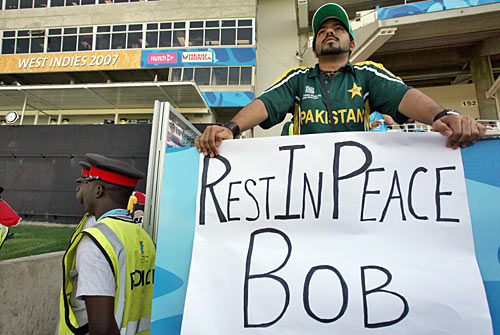
A Pakistan cricket fan pays tribute to Bob Woolmer, in Pakistan's final game which they won and dedicated to their late coach. photo AFP


The cricketing world is horrified to hear that the Jamaican police are treating last Sunday's death of Pakistan coach Bob Woolmer, the former Kent and England all-rounder regarded as one of the game's finest coaches, as murder.

Pakistan as one of the strong contenders to make the last eight, was ijected out of the tournamnet by debutant Ireland last weekend and angry fans took to the streets of the cricket-crazy Pakistan. This defeat was one of the biggest upset in the history of the 32- year old cricket tournamnet.

Emotions ran wild and Pakistani fans burnt coach Woolmer, 58, and captain Inzamam ul Haq in effigy. Hours later, the team's coach, was found dead in his Jamaican hotel room.

Now the police suspect foul play. A massive murder hunt is on in order to find out the perpetrators of this heinous crime. There was no forced entry into Woolmer's room and there is speculation that Woolmer was about to expose a match-fixing scandal. Stories about five bookmakers who have flown from the cricket-crazy sub-continent to Jamaica have also emerged fuelling conspiracy theories about the motive of the gruesome murder. The rumour mill is running on overtime last five days.

A former Scotland Yard detective is leading the investigation for the Jamaican police.

A devastated widow Jill described Woolmer as "a wonderful husband and a great father." She said Woolmer had a cheerful nature and a positive outlook on life and had a never-give-up attitude.

Speculation is rife that Woolmer's murder was the result of information he had on the mafia-style industry that makes billions of dollars from betting on international cricket matches. He was eliminated before he could blow the whistle.

The gentleman's game of cricket that the English introduced to its former terrories has lost its soul some time ago. The cricket's governing body the International Cricket Council, the ICC has not been able to clean up the corruption which has mired the game. Big money in the dark underworld of gambling and betting has also haunted this game. Nationalistic fervour and unfounded passion has made this game to be worshippied as a quasi-religion in the sub-continent.

It is time to do a reality check. The ICC president and others have said that the world cup should continue, for a disruption would send a signal of weakness to the criminals. So the world cup of cricket should continue for what it is worth. But has the ICC and others explained the worth of this sad spectacle? Is it worth the life of a human being, be it a coach, player or anyone else? Those who have the responsibility to run this sport have failed to provide adequate security to avoid such a tragedy, knowing very well that top players have been involved in match fixing in the past.

The game cannot be bigger than the life of a single individual. It is time for the organisers of this event to take a step back and put their house into order making sure that criminal elements have been rooted out. Woolmer's death has put a dampener on the World Cup, which will always be remembered for an awful tragedy.

Cricket has lost a sporting hero and and innovative coach.

Thursday, March 22, 2007

Dancing with one leg


Following her high profile divorce from Paul McCartney, the former model and human rights activist Heather Mills was vilified by the press especially in Britain. The tabloids portrayed Mills who has lost one of her legs to an accident as greedy, demanding a disproportionate settlement from the popular ex Beatle Paul McCartney.

Now she is getting kudos for her dance performance as the first ever contestant to appear on the American hit tv programme 'Dancing with the Stars,' with a prosthetic leg. Mills and her dancing partner Apolo Anton Ohno, danced the foxtrot to ‘Cheek to Cheek’ - the Irving Berlin classic.

More than 20 million US viewers tuned in to see Heather Mills foxtrot on the dancefloor yesterday, the biggest audience ever for a season premiere of the ballroom dancing show and clearly the most watched show of the night on US television.

She has overcome an adversity with a never-give-up attitude. She practised vigirously and received a standing ovation when she completed her dance without a fall. She got respectable marks from the judges who were very impressed with her effort. She said that she wanted to prove to the world that a handicapped, publicly despised person could come out on national television, overcome adversity and win.

All the money that she makes from this event is going to the charities she is involved with. Though she still has many skepics who continue to write negative publicity, this is an inspirational effort which is contributing to a good cause.

Wednesday, March 21, 2007

Anti-malaria mosquitoes emerge


Scientists at Johns Hopkins University have created Genetically Modified or GM mosquitoes by giving them a gene that makes it impossible for them to pass on the plasmodium that causes malaria.

"What we did was a laboratory, proof-of-principle experiment; we're not anywhere close to releasing them into the wild right now," revealed Dr Jason Rasgon of Johns Hopkins University.

The research provides evidence that engineering mosquitoes to resist the parasite could help to control a disease that takes up to 2.7 million lives each year, chiefly in Africa. Malaria infects between 300 million and 500 million people each year. Only HIV/ Aids causes more deaths from infectious disease.

The idea of the experiment is to release large numbers of GM mosquitoes where malaria is common, where they would interbreed with wild ones. Over several generations, resistance should spread through the mosquito population, so that fewer insects carry malaria.

Scientists are playing a deadly game with nature. In the past, killer bees were made in another such experiment and now they dominate in some parts of the world. Time will only tell whether the GM mosquitoe came out as result of a fool-hardy experiment.

Tuesday, March 20, 2007

Survival of the prettiest


“Survival of the Prettiest” is an interesting book which takes an evolutionary view and searches for what it is in nature that makes us susceptible to beauty and what qualities people possess that evoke these responses.


Many critics point a finger at the media for glorifying beauty, for the world's obsession with beauty.

In “Survival of the Prettiest: The Science of Beauty”, Dr. Nancy Etcoff attempts to portray an entirely new idea. She believes that appreciating beauty is not learned, but rather is a biological adaptation.

There is much more to beauty than the age-old cliché “beauty is in the eye of the beholder.” Different cultures view beauty or the objects of beauty in different perspectives.

Beauty is a subjective experience, beauty being the quality present in a thing or person that gives intense pleasure or deep satisfaction to the mind. Many in the English speaking world would remember the classic fairy tale of the sleeping beauty.

We equate beauty with what is desirable and good, the opposite of this being in ugly things that provoke our dispeasure. Therefore, we are attracted to appreciate beauty and Etcoff's book seems to suggest that this quality is imbedded in our genes.

Beauty has inspired humans throughout history, but it is in the recent history that the quest for the outer beauty has gained more recognition and fame over and above the important values of decency and morality.

Huge industries of different types of fashion and plastic surgery have emerged to cater for people who want beautify their pysical body and appearance. The look of youth and vitality commands a very high premium, leading some people to develop eating disorders due to their craving to look thin.

Instead of looking only to the outer beauty, we should look to the beauty of the inner person. When we identify only the external beauty, we discriminate people on the basis of their outer appearance. It will then become the survival of the sexiest.

Monday, March 19, 2007

Tributes flow for Bob Woolmer

Pakistan coach Bob Woolmer died on Sunday, a day that the cricket-crazy Pakistani fans were baying for his blood after the shocking elimination of Pakistan from the cricket world cup. Woolmer was found unconscious in his hotel room just hours after his team suffered a shocking loss to rank outsider Ireland.

Mass outrage at the loss in Pakistan overnight soon turned to mourning when team officials announced Woolmer, 58, died within an hour of being rushed to University Hospital in Jamaica.

Commenting on Woolmer's death Pakistan Cricket Board chairman Naseem Ashraf said, "He was a thorough gentleman who instilled team spirit in the team. He was a very popular personality in our cricket team."

Former Pakistan cricket captain turned politician Imran Khan has said that Bob Woolmer died just because of the team’s loss against Ireland. Imran Khan blamed the captain Inzamam-ul-Haq squarely for the loss. He said Woolmer had played his part but it was uninspirational leadership that brought the defeat.


Inzamam-ul-Haq, visibly distraught after Woolmer's death, has announced his retirement from one-day cricket and resigned as Test captain. He took responsibility for the team's loss.

The passing of Bob Woolmer in Jamaica has cast a sad shadow over the 2007 Cricket World Cup . Tributes have poured in from all across the cricketing world. Read them here.

Sunday, March 18, 2007

Irish march on St. Patrick's Day

The Irish cricket contingent at the Caribbean started the festival of St. Patrick's day, the anniversary to honour saints' deaths by crashing Pakistan out of the world cup.


Cricket is a quasi-religion in the Indian subcontinent. The day Pakistan was demolished by Ireland was also the day India lost to a weaker team, Bangladesh playing to its full potential.

The cricket mad nation of Pakistan is in mourning and the jury is out to decide the fate of the coach and the captain. Pakistan's captain, the affable Inzaman-ul-haq's illustreous career may be brought to an end. There will be no shortage of public opinion about the ineffective Packistan Cricket Board. Heads will certainly roll and discipline will have to be restored before fortune will bring back the past glory.

Knives are being sharpened in India whose fanatic cricket supporters see their team's back against the wall after their shock defeat to Bangaldesh. For India to advance to the knock-out phase it has to beat Bermuda on March 19 and Sri Lanka on March 23.

India knows beating Sri Lanka will not be a walk in the park. Rahul Dravid and co will have to pick themselves up and get the job done while millions are praying for their success.

Saturday, March 17, 2007

Easing arthritis


Read the benefits of this yoga.

A fitting swansong for Larsson


In a highly competitive world that glorifies the virtue of material benefits, loyalty is no longer a prized asset.

It is, therefore, somewhat surprising to hear so much praise of the Swedish footballer Henrik Larsson after he completed ten weeks with Manchester United and declined to extend his contract further.

Larsson provided three valuable goals for United in 12 appearances keeping Alex Fergusion's team in contention for three titles: the English premier league, the FA cup and the European championsip.

Fans and the media are pouring credit to a rare example of a footballer whose sense of loyalty, to both Helsingborg, his Swedish club, and to his family, outweighs even his sense of ambition. It is the 35-year-old’s attitude, as much as his talent, that has so endeared him to Alex Fergusion.

To hear Larsson talk of honouring his contract to his Swedish club and turn his back to the possibilty of treble titles with a great club like Manchester United, is a reflection of the the measure of a great man.

Larsson was given an emotional send-off from the United players in the dressing room after his last game. The Swedish forward ended his brief journey to Manchester United when he played as captain of a European team against United for the charity match played at Old Trafford.

Thursday, March 15, 2007

Investing for the long haul

Placing a value on the stock of a company is an important factor for every stockholder or for every investor who wants to buy or sell the stock. Such a valuation will show the market worth of the company.

Valuation is the first step toward intelligent investing. When an investor attempts to determine the worth of shares based on the fundamentals, the investor can make informed decisions about what stocks to buy or sell.

The stock market is a highly illogical place where greed and fear are strong market driving forces.

One of the most intelligent and disciplined investors who is a close second to the world's richest billionaire Bill Gates is Warren Buffet.

Buffet uses a techinique called value investing or growth investing wherein he looks for stocks that trade for less than their intrinsic value. Value investors actively seek stocks of companies that they believe the market has undervalued. They believe the market overreacts to good and bad news, causing stock price movements that do not correspond with the company's long-term fundamentals.

Typically, value investors select stocks with lower-than-average price-to-book or price-to-earnings ratios and/or high dividend yields. Value investors look for securities with prices that are unjustifiably low based on their intrinsic worth.

Intrinsic value is a tricky subject because there is no universally accepted way to obtain this figure. Most often intrinsic worth is estimated by analyzing a company's fundamentals. Two investors can be given the exact same information and place a different value on a company.

For this reason, another central concept to value investing is that of "margin of safety". This just means that you buy at a big enough discount to allow some room for error in your estimation of value.

The fundamental and technical debate:

Investors have been debating the success of investing on the basis of fundamental analysis versus the technical analysis. Fundamentalists look for the stocks consistent earnings improvement, strong profit margins and a high return on equity. Technical analysts use charts to study the movement of the market. Investors using either of this method would swear that theirs is the more profitable method.

Value or growth investors focus on the market rather than get worked up by what is happening with the DOW or S&P 500 index. Savy investors know how to decimate the clutter of noise in the 24/7 news media and select under valued stocks and keep track of them.

As the saying goes in the market, invest like a tortoise and profit like a hare.

As a growth investor, take a long-term view of investing without worrying over the day-to-day fluctuations of the economy, interest rates, and the overall market. In the longer term, these changing variable will have little impact on the growth stocks.

More on Value Investing.

Selecting stocks at the right time.

Wednesday, March 14, 2007

Separating the his-and-her bedroom

A new trend is setting in as usual in the United States, a trend that will soon race across the Atlantic to Britain and Europe and to the rest of the world.

In a survey in February by the National Association of Home Builders, builders and architects predicted that more than 60 percent of custom houses would have dual master bedrooms by 2015, according to Gopal Ahluwalia, staff vice president of research at the builders association. Many new projects already do.

Couples and sociologists interviewed said this trend has nothing to do with sex. It may have something to do with snoring or children crying. The need for privacy and space is more important when both partners have different careers and independent lifestyles. One may want to sound the alarm clock and rise up for the early morning gym, while the other may want to sleep late after working late into the night.

It started with the his-and-hers closet ... now the demand is for the his-and-hers bedroom. It's a market-driven demand that's catching on fast. It is a sign of the times, a statement of fashion and a reflection of the desires of an affluent society.

Tuesday, March 13, 2007

Pakistani Cricketers promoting tourism

The Cricket World Cup is upon us and 16 cricketing nations have gathered at the West Indies for what promises is to be an exciting tournament.

Pakistan Cricket Board (PCB) well known for their poor managment and disarray have come up with an ingenious idea to promote tourism for Pakistan.

Pakistan team's premier fast bowlers Shoaib Akhtar and Mohammad Asif both tested positive for nandrolone last September but had lengthy doping bans quashed on appeal in December after claiming they had not knowingly taken the banned substance.


The Pakistan cricket team has been banned from speaking in English at World Cup news conferences to prevent players from being misquoted.

"This decision was taken by the Pakistan Cricket Board because it is our national language and because 2007 is our National Tourist Year so we are promoting Pakistan as well," said a team spokesman.

Skeptics say this a way for the PCB to control the players even more. One of the PCB officials will be acting as tranlator in chief.

Pakistan plays West Indies in the World Cup curtain raiser at Sabina Park, Jamaica on Tuesday.

Monday, March 12, 2007

There's no secret in "The Secret"


This is the latest buzz among people who want guaranteed success in life.

"The Secret" is a rehashed book about the power of positive thinking that has been around for ages. Norman Vincent Peale and many others have written self-books on this concept.

The publisher Rhonda Byrne tells us that in 'The Secret' we can learn how to use every aspect of our life—money, health, relationships, happiness, and in every interaction there is in the world.

A some what emotional critique of this book points out some very pertinent facts.

The Secret is defined as the law of attraction, which states that like attracts like. The concept says that the energy you put into the world—both good and bad—is exactly what comes back to you. This means you create the circumstances of your life with the choices you make every day.

Does this work in every aspect of our life? If a ntural disaster were to happen, did the person who suffered will it to happen? It is wrong to suggest that it is the case. It is equally wrong to suggest that anyone can do anything if the person thinks, feels and takes action.

What is possible and what is achievable would be the goal a person has thought about and passionately takes action to attain it.

Hence from this book that is promoted as a self-help gospel, we should take what is workable for us and forget about the rest.

Sunday, March 11, 2007

Redefining hypocrisy

Republican Newt Gingrich, who led the U.S. House of Representatives to impeach Bill Clinton in a sex-and-perjury scandal, has told a Christian radio program he was cheating on his second wife at the same time as he was fighting for the impeachment of former president Bill Clinton.

Gingrich, who is testing the waters for his presidential ambition, is making an attempt to make peace with Christian conservatives ahead of a possible presidential campaign.

Gingrich confessed to Dr. James Dobson, a conservative radio host who runs a nationally syndicated program and spoke at length about past infidelity and his two divorces.

Gingrich argued that he wasn't a hypocrite for pushing for Clinton's impeachment while having an affair.

The impeachment spectacle that Newt Gingrich headed costing $7 million to the American tax payers failed to convince the majority of the Americans that the republicans are neo-puritans above personal indiscretions. Instead it exposed the family-values and hypocracy of the twice divorced Gingrich, while his foe Clinton though condemned for his personal indiscretion was spared.

Gingrich resigned as speaker of the House in disgrace and Clinton completed his presidency with very high public approval of his job rating.

Saturday, March 10, 2007

Rampant poverty in richest year

Forbes magazine has given out the head count, the number of billionaires has skyrocketed over the past year to 946 men and some women. There were 178 newcomers, including 19 Russians, 14 Indians, 13 Chinese and 10 Spaniards, as well as the first billionaires from Cyprus, Oman, Romania and Serbia.

Steve Forbes, the founder of the Fordes magazine has said that this is the richest year in human history. Forbes also said the best way to create wealth is to have free markets and free people, and more and more of the world is realising it.

JK Rowling, the Harry Potter author, has made it to the super rich club, making her the UK's sole female billionaire. Innovation will be the trend to develop ideas for future wealth creation.

In the 20 years since it began compiling the list, Forbes said, "old world powers like Japan and Germany - and the billionaires who dominate their businesses - have given way to the latest global hotspots such as booming China, India and Russia. Yoshiaki Tsutsumi was the world's richest person in our inaugural year, but the Japanese land baron fell off the list this year."

In a world of unprecedented wealth, a UNDP report shows almost 2 million children die each year for want of a glass of clean water and adequate sanitation. More than 2.6 billion people do not have access to safe water.

According to a World Bank report, 1.1 billion people in the world live on less than $1 a day. This is the measurement for extreme poverty.

Why is poverty still so endemic inspite of the potential and the continued creation of the gigantic wealth? Is there more to it than just blaming the poor for their plight? When the rich are soaring upto the sky why are the poor languishing so far behind?

For these numbers to be relevant, there is something radically wrong with a system that continues to deprive such a large segment of humanity. There must be critical issues that needs to be addressed in the interest of global peace and a sustainable economic development.

Friday, March 09, 2007

Naomi Campbell-super model to super mopper


Naomi Campbell, the leggy beauty will change her glamourous outfits for a broom, gloves and safety vest when she begins mopping floors at New York's Sanitation Department on March 19, a court official confirmed on Tuesday. She has to clean up the mess she has brought on herself.

The British 36-year-old model was sentenced to community service as punishment for throwing her mobile phone at her housekeeper.

She is a recovering cocaine addict who is reputed to have a quick temper, with several tabloid stories involving violence against her staff as well as verbal abuse.

She is now included among the stars brought down to earth, like singer Boy George who attracted huge media attention when he swept streets in a court-ordered punishment in August last year.

She is estimated to have so far acquired a wealth of US$28 million from modelling.

Thursday, March 08, 2007

Rule of Law wins in high political trial

Here is a case that has gripped Washington last few years, a trial that demonstrates the power of checks and balances in the American political system and an astounding victory for the rule of law.

The criminal conviction of one of the Bush administration's most powerful figures, Lewis Libby, the former chief of staff to Vice President Dick Cheney, has been found guilty on four counts of obstructing justice and lying to the FBI and a grand jury during an investigation into the leak of a CIA operative's identity.

Much of the perjury case hinged on the flawed intelligence for the case for war and the White House's campaign to justify the Iraq conflict. As Mr Cheney's former chief of staff and ex national security adviser, Libby was one of the architects of the Iraq invasion.

The offenses carry possible sentences of more than 20 years in prison, but because he is a first-time offender, Libby will probably receive substantially less under federal sentencing guidelines. His lawyer said he would move for a new trial and, if the motion is denied, would appeal.

The implications of this trial are likely to be far-reaching and long-lasting. There were few officials with greater influence or power during the first four years of the Bush administration than Libby.

Libby is one of the most well-connected neoconservatives in the US that advocated for an invasion of Iraq to overthrow Saddam Hussein long before the 9/11 attack .

This incident shows that the rule of law, though imperfect and sometimes slow typically prevails over a particular elected official or political movement.

American politics has seen high political drama before. Richard Nixon was reelected in 1972 with the largest landslide in American history, but he spent the next two years watching as his closest aides were hauled off to criminal proceedings in the Watergate scandal.

In 1974, Nixon himself was forced to resign from office and president Gerald Ford gave him a pardon that avoided the humiliation of having dragged him through the courts.

Widely considered the most investigated US President ever, Bill Clinton was impeached on December 19 1998 by the House of Representatives and subsequently acquitted by the Senate on February 12, 1999. The charges were perjury and obstruction of justice, arising from the Monica Lewinsky sex scandal.

Wednesday, March 07, 2007

Ghana's lavish anniversary

Ghana is marking the 50th anniversary of liberation from Britain, the first black African nation to gain political independence.

Thousands of ordinary Ghanaians, as well as heads of state and other dignitaries have gathered Tuesday in Ghana's Independence Square in the capital, Accra, to celebrate the event.

Independent Ghana, like many sub-Saharan African countries, has had a checkered political history marked by a series of military coups, which ended in 1992. But the country is now seen as a model democracy in the region.

Nigerian President, Olusegun Obasanjo, gracing the occasion as the guest of honour said that Africa's biggest problem was sustaining political stability.

"We substituted military rule for colonially handed down democracy and socialism for capitalism without a productive capital base," he said.

He said what is required is a clear understanding of the best way for Africans to bring political development and economic growth to the continent.

Ghanaian authorities have spent $20m (£10.4m; 15.2m euros) on the commemorations, which are due to continue for the next 12 months.

Critics have questioned the wisdom of holding such lavish celebrations while many in the country remain without basic services.

Accomplishing goals

This a reccurring theme that we hear over and over again. The capitalistic economic system is dominating the world and we are always competing with one another. Individuals, corporations and nations compete to derive a competitive advantage and increase profitability of business and services.

In this system, setting goals and attaining goals is an important benchmark for success. As individuals we can improve by our own efforts and in collaboration with other people. In order to continue succeeding in this 'fighting for survival' system, we need to be alert to the rapidly changing conditions around us.

We have to focus our energy and our efforts to achieve what we desire by making the choices that can help us advance. We have to associate with people who can positively contribute to us and strenghten our efforts.

We should not worry on things that are inconsequential and we should not try to get even with our enemies, for it will drain us of the much needed energy.

When we do things for other people, we should do them without expecting any gratitude but because it is the right thing to do.

Click here to read on attaining goals.

Tuesday, March 06, 2007

Avoid hot baths to improve male fertility


A three-year pilot study of infertile men in the United States has shown that wallowing in hot baths or Jacuzzis may be part of the problem.

It has been believed for decades that wet heat exposure is bad for fertility, as an old wives’ tale, but now we have some proof.

Other research from the Brazilian Society of Urlology reports that heat from laptop use and wearing tight underwear can also reduce fertility.

Monday, March 05, 2007

Being cool and getting addicted

The BBC Click programme highlights the 'rise of technology addiction', an addiction arising out of using cool gadgets which makes many people especially the younger generation feel fashionable to do so.

It was revealed at a technology conference in Geneva, Switzerland that "technology overload" is the price people have to pay for always-on communication, where the line between work and play has become blurred.


One major consequence of this phenomenon is that the line between work and private life is also much more blurred, and individuals highly dependent on techology to get by are reducing their capacity for social interaction.

It has become an important feature of business to inject fun into their products and services and the environments they operate in. In our lives, we will have to live with more technology which gives tremendous benefits to the people who can derive them without getting addicted.

Another East Asian Financial crisis?

After a two-day meeting of finance officials in Bangok, Mr. Kim Hak-Su, executive secretary of the Economic and Social Commission for Asia and the Pacific (ESCAP), has invoked the grim reminder of the 1997 East Asian financial crisis.

He said that Asian economies face new threats that could destabilise the region, despite the current boom that resulted from success in overcoming the 1997 financial crisis.

The East Asian financial crisis was a period of economic unrest that started in July 1997 in Thailand and affected currencies, stock markets, and other asset prices in several Asian countries.

Thailand was the epicentre of the 1997 meltdown when excessive borrowings in US dollars coupled with high interest rates forced the Thai government to float the currency, which then promptly collapsed along with the economy.

Many economists believed that the Asian crisis was created not by market psychology but by macroeconomic policies that distorted information which in turn created the volatility that attracted speculators.

The crisis had significant macro-level effects, including sharp reductions in values of currencies, stock markets, and other asset prices of several Asian countries.

Many businesses collapsed, and as a consequence, millions of people fell below the poverty line in 1997-1998. Indonesia, South Korea and Thailand were the countries most affected by the crisis.

The economic crisis also led to political upheaval, most notably culminating in the resignations of Prime Minister Chavalit of Thailand and brought an end to Indonesian president Suharto's 30-year autocratic regime.

There was a general rise in anti-Western sentiment, with George Soros and the International Monetary Fund in particular singled out as targets of criticisms.

What some of these leaders failed to realise was that investors who sepeculated in their stock markets didn't owe a living to the citizens of the countries where they traded. It is upto the leaders of these countries to regulate their markets, control their fiscal and monetory policies in a manner that can continue their economic growth without undue burden on the society.

Globalisation, along with its many benefits, exposes economies to quick and harsh reality of the constantly shifting international environment as we saw what happened last week when the former US Fed boss Alan Greenspan made a comment about 'recession' in Hong Kong.

The herd mentality quickly follows bad news when there is a rush to sell stocks as happened in China followed by the US and much of the global markets last week. In an an interconnected world, if economies are not operated on sound principles, the social consequences of a financial meltdown can be devastating.

Money is the lifebood of any economy, it also has the power to bring it to an abrupt standill.